Story Pitch – Reflection 7

Image Source: Yury Kim

If someone is hurt on the job, they are entitled to worker’s compensation, regardless of socioeconomic status, thanks to the Occupational Safety and Health Association (OSHA).

But are there people more likely to get hurt in the first place?

The CDC’s Health Disparities and Inequalities Report (CHDIR) provides some insight into this question that could suggest the answer is yes. According to the report’s section on fatal work-related injuries:

“Hispanics and foreign-born workers had the highest work-related fatal injury
rates (4.4 and 4.0 per 100,000 workers, respectively).”

In addition to this, the report notes that although Hispanic and foreign-born workers had the highest on-the-job fatality rates overall, ‘non-Hispanic blacks’ had either the highest or second highest fatality rates in many industry categories. So, is there a connection?

The U.S Bureau of Labor Statistics suggests that the majority of ‘high risk jobs’ (first responders, construction, heavy equipment operation, etc.) are not heavily populated by any specific race. That is to say, there is not a clear connection between minorities and being forced into high-risk careers. So why do the majority of on-the job deaths not include white workers?

The answer to the connection between race and an increased rate of death by on-the-job accidents could be from a variety of involved factors. It may be possible that the cause of increased fatality lies in the continued systematic oppression of non-white workers – meaning that minority employees in dangerous jobs may be worse off both health-wise and financially than their white co-workers.

An article about the connection between demographics and work injuries supports this idea by noting workers from ‘minority’ backgrounds face many more hazards than their white counterparts.

Avoiding these hazards that reduce quality of life for many individuals seems to be unfortunately unavoidable. Poverty among non-white individuals persists for generations due to systematic oppression and continually forces workers into less ‘educated’ professions due to lack of educational resources and discrimination, preventing them from breaking the cycle of abuse.

A 2013 report by Liana Christin Landivar notes that typically high-paying STEM careers are populated almost exclusively by white and Asian employees, and additionally notes a noticeable disadvantage to black or Hispanic students looking to get into the field, especially if they are women.

With no opportunity to get ahead and consistent challenges not faced by white employees, it becomes apparent that Hispanic and black employees in high-risk careers face many struggles that others do not. Their increased risk of fatality in the workplace, therefore, can be observed to be another deeply negative aspect of systematic oppression.

With higher rates of incarceration, a mishandling of ‘high risk youth,’ poor healthcare access, unfair housing practices, and many other factors, the case for racially-motivated disadvantage in the workplace is clearly evident.

With the odds overwhelmingly stacked against them, the connection between socioeconomic status, ‘class,’ and race and a higher chance of being injured at work does in fact seem to be a legitimate issue worth investigation.
The Price of Poverty – Reflection 6

Photo Credit: Sergio Omassi

Imagine this: you’ve lost your job, your home, your savings. You’re down to your last $1000. You have no college degree – and you’re supporting a young child. Where do you go from here?

This is what Spent asks its site visitors to think about. “PlaySpent” is a game created to help people understand the real weight of poverty and the challenges that some people face every day.

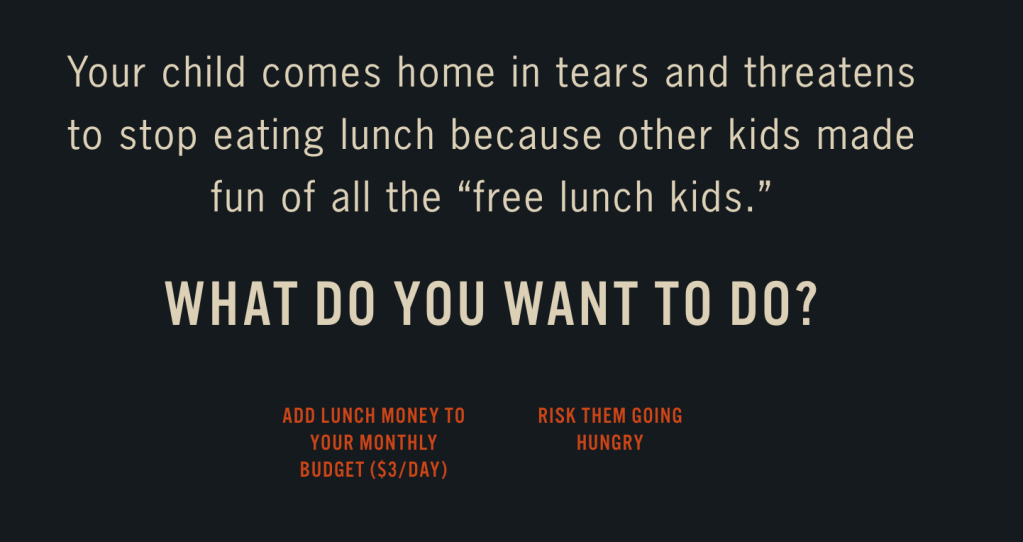
The ‘game’ asks you to make a variety of choices – what low-paying job to apply for, where to live, what insurance to pay for. The most startling choices, however, are like the one above, which asks what the player would do in the face of their child being bullied – pay an extra expense, or allow their child to be tormented and potentially starve?

Spent exposes some heartbreaking truths about poverty. The impossible choices that Spent asks players to make are real events in the lives of many in the United States, unfortunately. According to NPR, about 1 in 8 people live below the poverty line in the U.S., and this game is their reality.

The situation players of Spent find themselves in is one they likely imagine they will never find themselves in. Losing everything with no way to move forward is a bleak and harsh reality which unfortunately is not fiction.

A statement I’ve often heard about the impoverished and unemployed is “why don’t they just get a job?”

There seems to be an assumption in much of U.S. society that people that are poor are suffering because of their own ‘bad choices.’ The reality, in most cases, is actually that poverty is a cycle from which most have no opportunity to escape.

Many in poverty grow up in already poor and difficult homes and have no access to education that would give them a ticket out. Discrimination and minuscule job opportunities mean that most people under the poverty line will stay there.

Michael B. Sauter’s Faces of Poverty gives a glimpse into the real appearances of the lives we emulate in PlaySpent. Minorities, women, children and people with disabilities populate the eleven point list.

On top of limited resources and money, these people also face discrimination for their gender, race and physical or mental ability. With hurdles like that to overcome, how can you even begin to jump?

Race and the Media – Reflection 5

Photo Credit: hermaion

Race and ethnicity in the news is a complicated subject. Whether or not race should be mentioned in news stories is a topic often discussed by journalists. While it can be necessary to tell the entire true story in some cases, it can directly harm real people in others, depending on the content of the story.

undefined

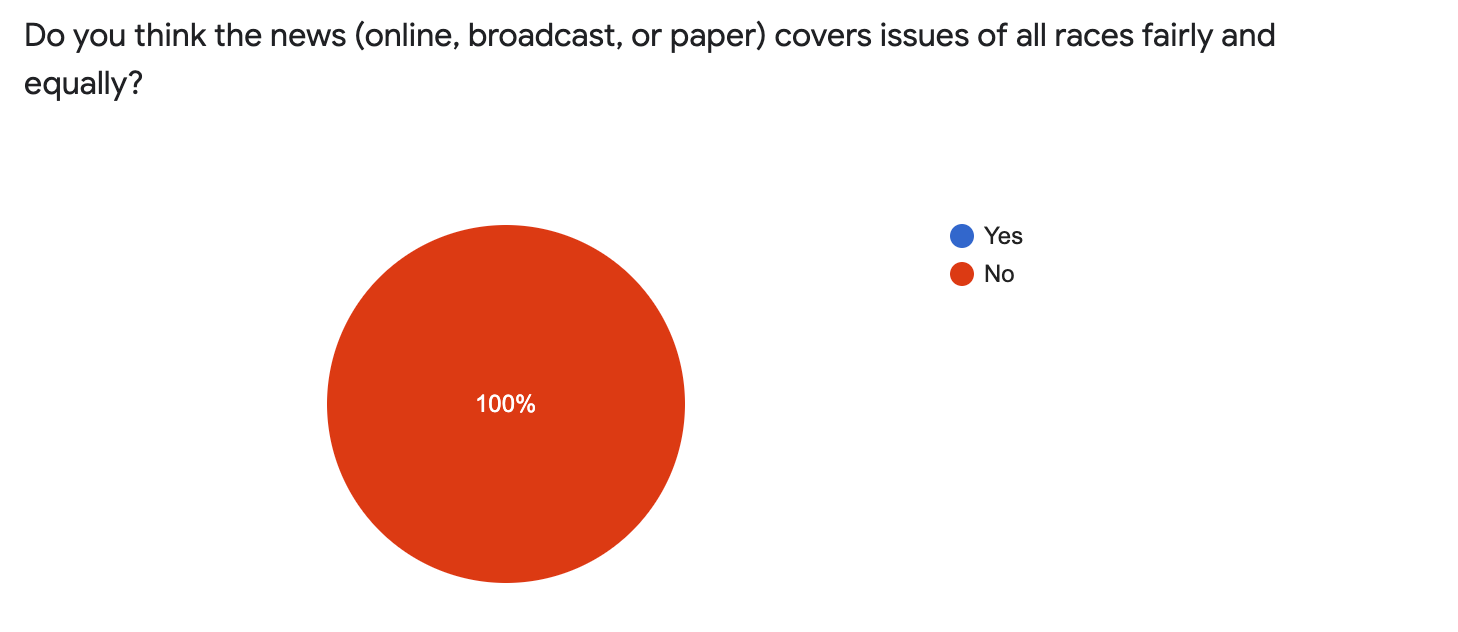
In a small social media survey conducted via Snapchat, 100% of participants agreed that the news, in general, does not handle issues of all races fairly and equally.

Participants of the survey were students currently attending college, the majority from Oakland or Grand Valley State University. While this was a small poll and reflects only the views of a small group of college-attending students, there is evidence of an ever-growing universal mistrust of the media in these matters.

A Gallup poll found that only 41% of Americans have a “fair amount” of trust that the media reports news fairly and accurately. And, according to Meredith O’Brien of Inside Higher Ed, “a May 2019 Quinnipiac University poll found that 23 percent of respondents said they believe the news media are the “enemy of the people.”

With this general mistrust of the media in mind, it is not hard to understand the point of view of the poll participants. If news organizations can barely be trusted to handle facts, are they really equipped to discuss issues of race in a fair and truly truthful manner?

undefined

The last question of the survey asked participants to explain why they thought news coverage related to race was unfair, if they’d answered that it was. The above response references the large number of perceived acts of terrorism covered in the news suspected to have been committed by people of color as opposed to white suspects.

undefined

Other responses, such as the one above, showed a belief that the media are deliberately racist to uphold an agenda of white supremacy.

Overall, participants of the poll answered that the media was mishandling issues involving race and ethnicity. Most responses indicated a desire for real news about and by people of color to be more widely shared, not just the ‘white perspective.’

Since the survey was conducted, there have been a number of events in the media relevant to the responses. Widespread racism toward ‘people of east Asian appearance’ during the spread of Coronavirus to Australia and the U.S. was recently covered in The Guardian by journalist Jing Zeng.

Zeng’s article suggests sensationalist media is to blame for the heightened bigotry. Whether sensationalist or simply mishandling of information, it is clear from both the recent news and the survey above that the media has a long way to go in fair representation of minorities.

Separate and Unequal – Reflection 4

Photo Credit: Nguyen Nguyen

The Civil Rights Act of 1964 outlawed segregation 56 years ago – but today, schools are more segregated than ever before.

Dana N. Thompson Dorsey’s study, Segregation 2.0: The New Generation of School Segregation in the 21st Century explores this issue in depth. According to Dorsey, students increasingly attend schools made up mostly, if not entirely, of their own race. She says:

“About 74% of Black students and 80% of Latino students attending schools that were 50% to 100% minority and, more specifically, more than 40% of Black and Latino students were attending schools that were 90% to 100% minority (NCES, 2012). Furthermore, approximately 15% of Black and Latino students attend schools that are 99% to 100% minority.”

In other words, she explains, segregation in schools has not lessened in the half century since the Civil Rights Act of 1964. Segregation by law is illegal – so why is it still persisting in the public school system?

There are many reasons – most of which reflect a structure of upheld systematic racism. The United States is more diverse in population than ever before, but housing still tends to be segregated. The origin of segregated neighborhoods dates back decades in many communities and is often held together by varying costs of living and housing laws.

Reasoning for avoiding integration in favor of segregation varies, but is usually impacted by continuing inequality. According to a ThoughtCo article, black students are three times more likely to be suspended or expelled. The same article also states that black students are less likely to be labelled with the status of ‘gifted’ or advanced, despite getting grades equal to those of ‘gifted’ students. The author states:

“Because when children of color have teachers of color, the chances are higher that they will be identified as gifted. This indicates that white teachers largely overlook giftedness in black and brown children.”

That said, it is easy to understand that parents would want their children to have better opportunities and face less discrimination and therefore place them in majority-minority schools. As a result of this and many other factors, schools continue the trend of segregation.

undefined

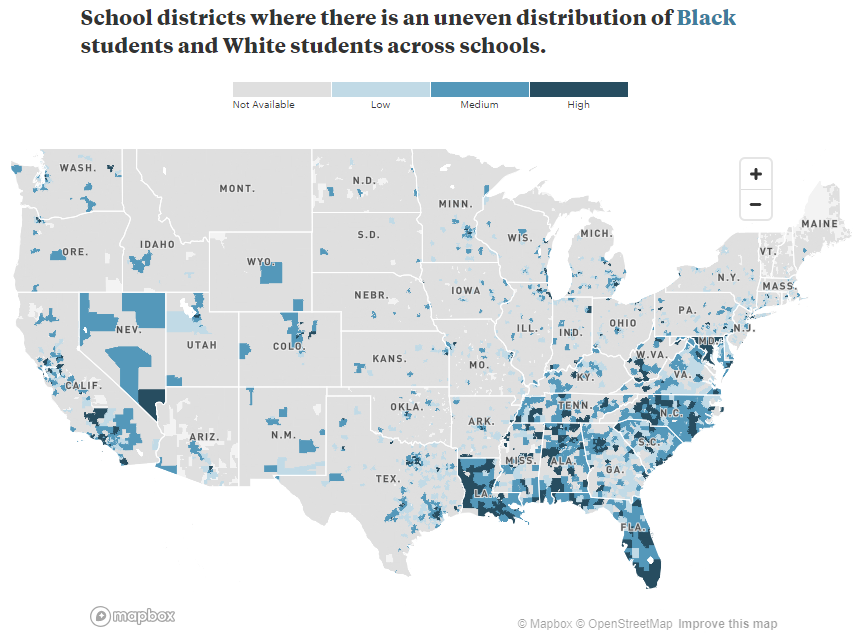
The graph above is a diagram from ProPublica, part of a series that measures racial inequality in schools across the United States. The concentration of more highly segregated schools in some areas speaks volumes.

So why does it matter? Is it bad to have all white or all black schools? The short answer is, yes. The systematic racism that creates segregation like this also puts schools that are mostly minority in population at distinct disadvantages. According to a New York Times article, school districts that serve students of color received $23 billion less in funding than white school districts in 2016, even though they serve the same number of students.

With students of color receiving less educational funding and facing discrimination no matter where they choose to go to school, it is clear that the issue of school segregation is still very alive in 2020. But what can be done about it?

News organizations must cover the stories of people of color and their systematic disadvantages in education. The only way to fix this problem, I think, is through increased awareness of the issue. Whether through privilege or lack of exposure, white families may not understand the lack of funding and distinct disadvantages that minority families face when sending their children to school.

Increased reporting on difficult subjects such as schools segregation and other forms of institutional racism is the only way to bring these issues to the light. People’s world-views are shaped by the media they consume. If we pay attention to minority groups and begin to report crime and news related to minorities more fairly, journalists and others in the media can have a direct positive effect on the issues.

As we learned, implicit bias and privilege are difficult topics to learn about and grow through personally, but it is absolutely necessary for journalists to examine their biases and work toward reporting the news as objectively as they are able.

Implicit Bias – Reflection 3

Photo Credit: Daria Shevtsova

If you have ever heard the saying “what you don’t know can’t hurt you,” you know that’s not entirely a true statement. In fact, it can be very false, depending on the usage. A great (or perhaps unfortunate) example of this in the media, as well as life in general, is implicit bias.

Implicit bias can be sort of an elusive thing – hard to recognize until it’s brought to your attention. Most all of us harbor these biases in varying degrees. Implicit bias is a byproduct of where you grew up, how you were raised, your religion and so on. So what exactly is it?

According to Kirwan Institute for the Study of Race and Ethnicity, implicit bias is “the attitudes or stereotypes that affect our understanding, actions, and decisions in an unconscious manner.” This refers to ‘knee-jerk’ reactions we have upon seeing people different than ourselves, both positive and negative.

Implicit bias crops up in journalism quite a bit. Every reporter has a different background, so it’s easy to understand that no two people will see a situation exactly the same way. Sometimes, though, implicit bias is a little uglier and becomes borderline gross negligence. For example:

University of Alabama research found that terrorist attacks involving Muslims received 357 percent more coverage than attacks by others. White terrorists have committed nearly two times more attacks than Muslim extremists – so why don’t we hear more about those incidents?

The answer, unfortunately, is racist implicit biases. As explained by Franklin Gilliam Jr. and Shanto Iyengar in their article ‘Prime Suspects,’ race and crime can become synonymous when repeatedly presented in the media. If only black faces are shown as the suspects for crimes on television, viewers may begin to associate the two with each other.

Similarly, when only people that ‘look’ or ‘sound’ Muslim are shown as terrorists on the news, viewers develop an offensive stereotype. Then, when those viewers report the news, they of course show the ‘Muslim’ terror attacks. To them, Muslim people and terrorists are synonymous. It is unlikely that the reporters delivering theses stories would consider themselves Islamophobic – yet they continue to deliver more of these stories.

That being said, I think a lot of reporters and even just regular people really are unaware of their biases. Some ideas are so deep below the surface that we do not even realize we hold them. People interested in digging into what biases they might hold can take tests online at Project Implicit to delve into the subject. It can be very revealing.

I took several of the tests and was alarmed at some of my results. One of the tests, which is meant to investigate the link between gender and science, was particularly surprising for me. Feminism and the empowerment of women is a huge part of what I believe in and what inspires me, but taking this test my results showed that I naturally associated math and science as being ‘for men’ and the humanities and arts as being ‘for women.’

There’s nothing wrong with arts and humanities – I’m a journalism major! But the fact that by principle I saw math and science as a man’s thing really stung me. When I think ‘scientist,’ I do think of a man in a lab coat. I think women absolutely can and should be scientists. So why do I automatically think first of a man?

I think a lot of people hold implicit biases like these. Internalized sexism, racism, and homophobia are very real and widespread. Implicit bias is harmful; it can skew our reporting and cause unwarranted and unintentional hurt. It will take a long time, I think, to minimize and erase the damage we inflict little by little with these deep-rooted fears and prejudices. But being aware of implicit bias and working to overcome it is a good first step.

Power, Privilege and Language

Photo Credit: Danilo Ugaddan

Growing up, I was always aware that being white had its inherent advantages – but I could never have imagined the extent.

I grew up in a very tiny, rural and conservative town. The community was almost entirely white. I was never victim to racist remarks or unfairness. I always felt fairly comfortable in my community and like I had the tools to do whatever I wanted in life. I was ‘smart’ and expected from a young age that I would go to a good college and get a good job. I didn’t have to try very hard in school, and I had all the tools necessary to assure I made it through easily and without a hitch. And here I am now, college. Just like it was the next logical step.

I realize now that it isn’t like that for everyone. I’d never really thought about that until I went to college, maybe because it’s almost a hard pill to swallow. The whole process – graduating with good grades, getting into a university – felt rather easy to me, which I always attributed to being ‘smart.’ But a lot of people are smart, and not all of them get scholarships to attend college or to live on campus far from home.

Like Peggy McIntosh states in “White Privilege: Unpacking the Invisible Knapsack,” “My schooling gave me no training in seeing myself as an oppressor, as an unfairly advantaged person, or as a participant in a damaged culture. I was taught to see myself as an individual whose moral state depended on her individual moral will.”

I always saw myself that way, too. The classic narrative of working hard to achieve something and ‘pulling yourself up by your bootstraps’ seemed very attainable to me. But I realize now that perhaps my view of a guaranteed education and career was unfairly granted to me, and I was maybe even a little entitled to think it was something I was promised.

Being white, I have had all the opportunities and tools I’ve ever needed to succeed. I was provided with everything I needed as a child to learn and advance my education – others do not get that chance. People who aren’t white, straight, or male are at an automatic disadvantage and are constantly reminded of such through mistreatment, inappropriate remarks, and the many sinister effects of institutional racism.

It took me a long time to realize, but I never watch the evening news and see people of my race being called ‘terrorists.’ I don’t have to fight to see people that look like me represented in movies. People don’t assume I got my job or a scholarship because of the color of my skin.

Though it is invisible to many white people, white privilege is a tangible thing. Many of the privileges and opportunities white people enjoy are advantages we hold onto and claim without thinking why – but those advantages need to be seriously re-evaluated. For our society to ever be rid of institutional racism, I think white privilege needs to be addressed and brought to light for those that do not even realize they benefit from it.

The Problem with the Grammys’ “Urban” Category – Reflection 2

Photo credit: Frederic J. Brown, Getty Images

Tyler the Creator won Best Rap Album for “Igor” at this year’s Grammy Awards… but it wasn’t a rap album.

Igor is Tyler Okonma’s latest solo album under the name “Tyler, The Creator.” It was released in summer 2019 and was arguably his most successful album to date. It featured a ‘genre-bending’ style and more instrumentals and singing than any of his previous work. Genre-wise, I wouldn’t say it fits one single category. There’s a blend of pop, electronic and rap in every track on the album. So why, at the Grammys, did it just win ‘Best Rap Album?’

Tyler says it best himself in a backstage interview. “It sucks that whenever we – guys that look like me – do anything that’s genre-bending or that’s anything they just put it in a rap or ‘urban’ category. I don’t like that ‘urban’ word, it’s just a politically correct way to say the n-word, to me,” he told reporters.

The Grammys have a long history of white, male dominance and black artists have definitely not been treated fairly by the music industry. While there is more diversity in the Grammys now than ever before, with 2020 winners like Lizzo and Anderson .Paak, whiteness still seems to dominate. Billie Eilish won Album of the Year, Record of the Year, Song of the Year and Best New Artist. While she is the youngest person and first woman to win all of the main Grammy categories in one year, she is also wealthy and white.

The issue with the Grammys boxing artists like Tyler, The Creator into ‘rap’ is that they are choosing not to acknowledge their work at the same artistic level they hold to Billie Eilish. In calling the new, creative sound Tyler made with Igor ‘rap,’ the Grammys are really just saying they think it’s ‘black music.’ Igor does things musically that I think are right on par with Eilish’s music, if not better.

When the biggest winners at the Grammys are white again and again, it erases the work of so many amazing artists. The lack of more diverse artists in the award winners lineup each year silences non-white artists in a quiet, seemingly non-malicious way. This silence, however, deprives the music industry of a great deal of amazing content – and shuts down voices that deserve to be heard.

A Different Story – Reflection 1

In a perfect world, the news stories we consume would all be fully accurate, truthful and excellent accounts of whatever event they are covering. We do not live in a perfect world. News stories are written by humans, and as humans we are all influenced by a massive variety of factors – including but not limited to the way we were raised, where we’re from, our political opinions, our religion, etcetera. With this in mind, can any reporter ever truly capture every angle of a story?

Through this lens, I examined the differences between two news sites’ coverage of the same story. Both the Los Angeles Times and El Diario Nueva York wrote about an American Civil Liberties Union (ACLU) complaint against Orange County this week – yet the articles are alarmingly different in the tone and story they convey to readers. The LA Times’ piece about the situation reads like a tragic tale of someone you’ll never meet. The article’s lead primes readers for what will undoubtedly be a story of heartbreaking injustice:

“Kelvin Hernandez Román was driving a friend’s car in Tustin in July when police stopped him because the tinted windows on the vehicle were too dark.”

The story tells of two men unrightfully detained by Immigration and Control Service of Customs (ICE) and why ACLU filed complaints about the treatment of the two men by both law enforcement and ICE. The account is accurate – but why is it so different from the article in El Diario about the very same story?

El Diario is not a “mainstream” news source like the LA Times. It is a New York based Spanish language daily paper, and seeing as it is written for a Spanish-speaking audience, the content tends to be different than what is published in papers like the LA Times.

El Diario covers the ACLU legal complaints similarly to the LA Times, at first. They give a rundown of the story, the names of the two men detained and other basic facts. The second half of the article, however, is an eight point list about knowing your rights in the case that you are wrongfully arrested and detained by ICE.

“The police and sheriffs cannot ask you about your immigration status,” the article says. “They cannot share your personal information, such as your address, with either ICE or with the border patrol, unless it is publicly available.”

The differences between these two articles center on the backgrounds of their respective authors and the audiences that each paper serve. The LA Times is written for English-speaking people, likely California natives. The audience that LA Times reporters are writing for likely isn’t worried about being detained by ICE, they are merely reading about it happening to others.

El Diario, however, is writing to people living in fear of ICE. Its Spanish-speaking readers very well could be targets of unwarranted ICE arrests simply because they might look or speak differently than ‘non-immigrant,’ mainly white Americans. It is a small difference, to include the rights one has upon arrest by immigration police, but it is definitely a notable one.

The failure to represent the Spanish-speaking American audience in mainstream media in this instance, I think, sheds light on an interesting point about our perception of news. Even when we might believe we are getting the complete story, there are likely other points and angles we would never even think to consider that exist beyond our own individual perceptions. The experiences of the American news audience are not universal – and I think we are doing ourselves a disservice in not listening to voices different than our own.

Design a site like this with WordPress.com
Get started