

Image Source: Startup Stock Photos
Health and Education
According to AAFP.org, “adults who don’t finish high school can expect to live nine years less than their college-educated peers – and that gap is widening.”
The link between education and health is an interesting one, though hardly perplexing. As AAFP puts it, “education typically leads to better jobs, more money and many other benefits, including better health insurance, which leads to better access to quality health care. Higher earnings also allow workers to afford homes in safer neighborhoods as well as healthier diets.”
Local Numbers
I live in Shiawassee County, a rural mid-Michigan county with a current population of around 68,000, according to the U.S. Census. 90.5% of our population 25 years and older has an education level of ‘high school graduate or higher,’ which is good to hear. 17.2% say they also have a Bachelor’s Degree or higher – which would be about 11,000-12,000 people.
I decided to look at Oakland County as well, to see if we country folk were any less educated than the people of Metro Detroit. Turns out, we are. The percentage of people 25 and older in Oakland County with their Bachelor’s Degree or higher was 46.4%, which is more than double Shiawassee County’s numbers.
Besides the educational disparity, Oakland County and Shiawassee had some other interesting and notable differences. Households with a computer were around 6% higher in Oakland than Shiawassee, which could be attributed to Shiawassee being more rural, though I think household income has a little to do with it, too.
The median household income in Oakland County as of 2018 was $76,387, while Shiawassee’s was $54,724. This is reflected in the poverty rate as well, which sits at 10.8% for Shiawassee and 8.2% for Oakland.
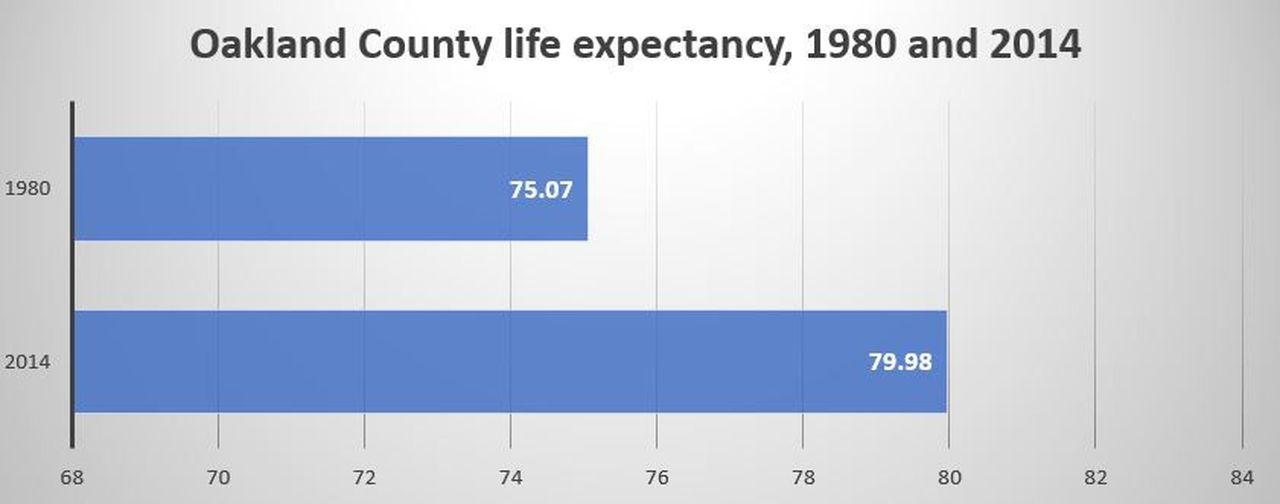
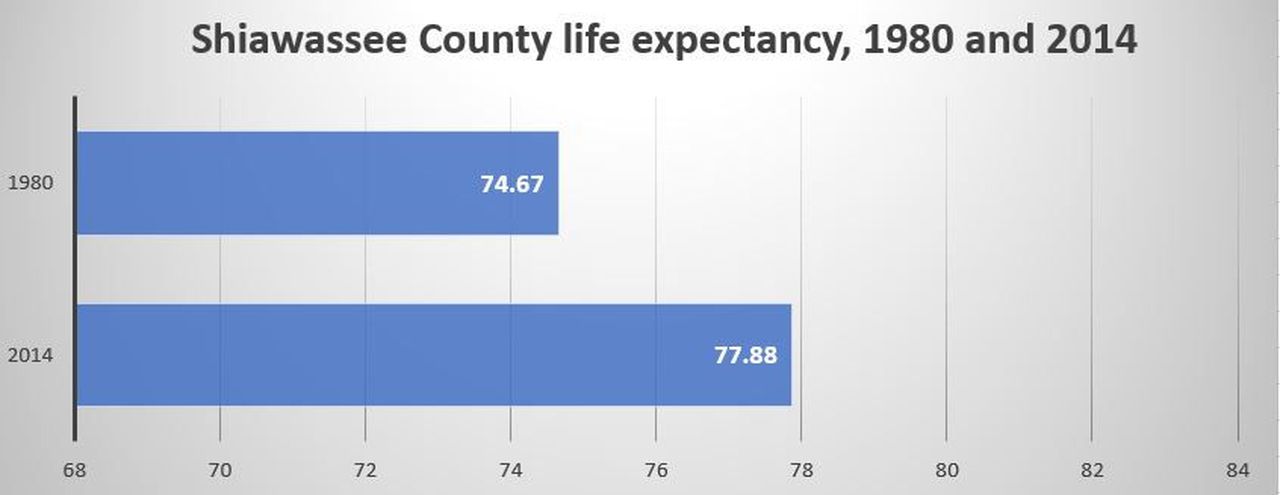
The life expectancies of Oakland and Shiawassee County, comparing 1980 to 2014. The data shown represents the life expectancy for both genders, which most recently was 79.98 in Oakland County and 77.8 in Shiawassee. Source: MLive
As a final comparison, I also looked at life expectancy to test the theory that educated people tend to live longer than those less educated. The life expectancy in Oakland County was 82 for women and 77.8 for men, as of 2014. In Shiawassee, it was 80.2 for women and 75.5 for men. As I had expected to find, life expectancy for both men and women is around two years less in my county.
Connecting the Dots
So, is there a connection between education and health here? I would say yes. The populations are admittedly a little difficult to compare because Shiawassee is considerably more rural and Oakland County’s population is about 18 times the size of Shiawassee’s. There are certainly other factors contributing to the lower income and health of people in mid-Michigan as well – but looking solely at education, I would venture to say it is a factor.
According to the National Bureau of Economic Research, “those with more years of schooling are less likely to smoke, to drink heavily, to be overweight or obese, or to use illegal drugs. Interestingly, the better educated report having tried illegal drugs more frequently, but they gave them up more readily.”
‘With less education comes less money and poorer health’ seems to be a hypothesis that rings true when looking at my rural county. This lack of education is not confined to mid-Michigan, either – rural areas across the country are known to be less educated.
This excerpt from a piece in The Atlantic by Jon Marcus and Matt Krupnick illustrates a potential reason why:
“When they’re ready to be done with high school, they think, ‘That’s all the school I need, and I’m just going to go and find a job’” on the family farm or at the egg-packaging plant or the factory that makes pulleys and conveyor belts, or driving trucks that haul grain.“
From a personal perspective, I think this is absolutely true. I grew up on and around farms and I think the idea that staying local and working at the family business is a very common plan where I’m from. The lack of education that this brings with it creates a cycle of staying away from higher education almost purposefully, I think, because anti-intellectualism seems to breed in these rural areas as well. There’s another interesting piece in the Atlantic about that and how it has affected our politics in the U.S. – but that’s a story for another time.
For now, the point is this: less education in rural areas, even in Michigan, is a real thing and is right there in the Census data. This does also seem to negatively affect the health and life expectancy of people living in rural areas.
Can we improve household income and the health of people living in those areas when they either don’t have access to or turn away the opportunity for higher education? It’s a question with no good answers yet, but one that deserves looking into.
If you’d like to check out the county statistics and comparisons for yourself, click here.
 Sidney Richardson: Blog