

Photo Credit: Nguyen Nguyen
The Civil Rights Act of 1964 outlawed segregation 56 years ago – but today, schools are more segregated than ever before.
Dana N. Thompson Dorsey’s study, Segregation 2.0: The New Generation of School Segregation in the 21st Century explores this issue in depth. According to Dorsey, students increasingly attend schools made up mostly, if not entirely, of their own race. She says:
“About 74% of Black students and 80% of Latino students attending schools that were 50% to 100% minority and, more specifically, more than 40% of Black and Latino students were attending schools that were 90% to 100% minority (NCES, 2012). Furthermore, approximately 15% of Black and Latino students attend schools that are 99% to 100% minority.”
In other words, she explains, segregation in schools has not lessened in the half century since the Civil Rights Act of 1964. Segregation by law is illegal – so why is it still persisting in the public school system?
There are many reasons – most of which reflect a structure of upheld systematic racism. The United States is more diverse in population than ever before, but housing still tends to be segregated. The origin of segregated neighborhoods dates back decades in many communities and is often held together by varying costs of living and housing laws.
Reasoning for avoiding integration in favor of segregation varies, but is usually impacted by continuing inequality. According to a ThoughtCo article, black students are three times more likely to be suspended or expelled. The same article also states that black students are less likely to be labelled with the status of ‘gifted’ or advanced, despite getting grades equal to those of ‘gifted’ students. The author states:
“Because when children of color have teachers of color, the chances are higher that they will be identified as gifted. This indicates that white teachers largely overlook giftedness in black and brown children.”
That said, it is easy to understand that parents would want their children to have better opportunities and face less discrimination and therefore place them in majority-minority schools. As a result of this and many other factors, schools continue the trend of segregation.
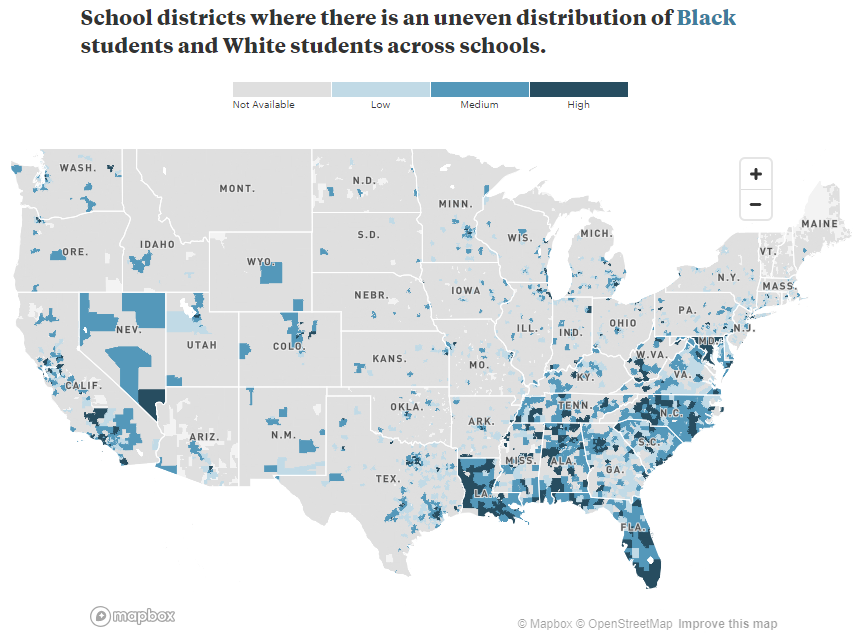
The graph above is a diagram from ProPublica, part of a series that measures racial inequality in schools across the United States. The concentration of more highly segregated schools in some areas speaks volumes.
So why does it matter? Is it bad to have all white or all black schools? The short answer is, yes. The systematic racism that creates segregation like this also puts schools that are mostly minority in population at distinct disadvantages. According to a New York Times article, school districts that serve students of color received $23 billion less in funding than white school districts in 2016, even though they serve the same number of students.
With students of color receiving less educational funding and facing discrimination no matter where they choose to go to school, it is clear that the issue of school segregation is still very alive in 2020. But what can be done about it?
News organizations must cover the stories of people of color and their systematic disadvantages in education. The only way to fix this problem, I think, is through increased awareness of the issue. Whether through privilege or lack of exposure, white families may not understand the lack of funding and distinct disadvantages that minority families face when sending their children to school.
Increased reporting on difficult subjects such as schools segregation and other forms of institutional racism is the only way to bring these issues to the light. People’s world-views are shaped by the media they consume. If we pay attention to minority groups and begin to report crime and news related to minorities more fairly, journalists and others in the media can have a direct positive effect on the issues.
As we learned, implicit bias and privilege are difficult topics to learn about and grow through personally, but it is absolutely necessary for journalists to examine their biases and work toward reporting the news as objectively as they are able.
 Sidney Richardson: Blog
woah another great article! racism in our education system is terrible. keep up the good work bro
LikeLike